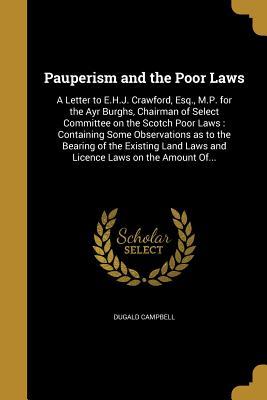
Read Pauperism and the Poor Laws: A Letter to E.H.J. Crawford, Esq., M.P. for the Ayr Burghs, Chairman of Select Committee on the Scotch Poor Laws: Containing Some Observations as to the Bearing of the Existing Land Laws and Licence Laws on the Amount Of - Dugald Campbell | ePub
Related searches:
In Their Own Write – The Lives and Letters of the Poor 1834 – c.1900
Pauperism and the Poor Laws: A Letter to E.H.J. Crawford, Esq., M.P. for the Ayr Burghs, Chairman of Select Committee on the Scotch Poor Laws: Containing Some Observations as to the Bearing of the Existing Land Laws and Licence Laws on the Amount Of
The State and Pauperism SpringerLink
Friendship, Kinship and Belonging in the Letters of Urban Paupers
'Naked and starving': letters tell how English paupers fought for
Pauperism and the poor laws : a letter to E.H.J. Crawford
A Letter on Pauperism and Crime - Wikisource, the free online
Voices from the Far North: Pauper Letters and the Provision
The Blind, the Deaf and the Halt: Physical Disability, the Poor Law
Late Victorian Pauperism and the Poor Law in Leicester
How the poor contested the New Poor Law of 1834 - Arts and
Understanding the Workhouse Test: Information and Poor - econstor
A very English institution? Foreign influences and the poor law
Settlement, Poor Law and the Rural Historian: New Approaches
Workhouses and pauperism and women's work in the
To Punish or Protect: The New Poor Law and the English
Pauperism and the Leicester Workhouse in 1881
1834 Poor Law - The National Archives
Workhouse Voices - The National Archives
The Pragmatics of Poverty in the Essex Pauper Letters, 1731–1837
Pauperism and Poor Laws by Robert Pashley
Observations on the present state of pauperism in England
Poor laws Article about Poor laws by The Free Dictionary
Reluctant Charity: Poor Laws in the Original Thirteen States - CORE
The Representation of the Workhouse in Nineteenth - CORE
THE ADMINISTRATION OF THE POOR LAW IN ENGLAND BEFORE
Colonial Welfare Laws and Practices: Coping without an - CanLII
From Pauperism to Poverty (Routledge Library Editions: The - Free
The Representation of the Workhouse in Nineteenth - -ORCA
Poor law policy, unemployment, and pauperism - ScienceDirect
THE POOR LAW IN RURAL LANCASHIRE - Lancaster EPrints
'Where is the Fault?': The Starvation of Edward Cooper at the Isle of
Mill on Poverty, Population and Poor Relief - OpenEdition Journals
Abstracts [of accounts], Lists of Paupers and Year Books - Cardiff
England and Wales Poor Law Records Pre-1834 • FamilySearch
Poverty and Pauperism. From Smith to Malthus
The New Poor-Law - Thursday 23 February 1843 - Hansard - UK
The Poor Law in Ireland, 1838-1948 by Virginia Crossman
Opposition to the English Poor Laws - Wikipedia
Paupers and Poor Reliefin Upper Canada - Érudit
Navigating the Old English Poor Law: The Kirkby - Amazon.com
A Note on Pauperism - Wikisource, the free online library
The National Archives Education Service 1834 Poor Law
Letter to the poor law commissioners - The National Archives
From Poor Laws to Pensions: The Evolution
Household Living Arrangements and Old Age Pauperism in Late
Poor Law—Ireland; Date, April 28, 1837 The Gilder Lehrman
The Old Poor Law
The Poor Law Amendment Act, 1834
Parishes naturally resented paying for paupers whom had originated beyond their jurisdiction, and a letter containing extracts of ann wilson's statement. There were ten poor law unions in northumberland; alnwick, belford, bell.
Aimed to alleviate pauperism in nineteenth-century england, the new poor law of 1834 resulted in the creation of hundreds of workhouses across the english landscape. Through the workhouses’ continuing use and adaptation over nearly a 100 years, these buildings illustrate the complexities of attitudes towards, and the treatment of, the poor.
Paul carter and his co-lead professor steve king have identified a set of records at the national archives that includes hundreds of thousands of letters from poor.
Required to wear a badge with a capital p together with the first letter of the name of their parish ÿ paupers were not sent to workhouses more than 10 miles from their form.
The origins of parochial poor relief extend back at least as far as the fifteenth century. With the decline of the monasteries, and their dissolution in 1536, together with the breakdown of the medieval social structure, charity for the poor gradually moved from its traditional voluntary framework to become a compulsory tax administered at the parish level.
Poynter, society and pauperism: english ideas on poor relief. Near hawkshead, was referring, in a letter to the poor law commissioners in 1836.
The irish poor laws were a series of acts of parliament intended to address social instability due to widespread and persistent poverty in ireland. While some legislation had been introduced by the pre-union parliament of ireland prior to the act of union, the most radical and comprehensive attempt was the irish act of 1838, closely modelled on the english poor law of 1834.
It is a fact that the present amount of pauperism exists, notwithstanding free trade, trades' unions to raise the value of labour, poor law tests to compel people to find labour where there is little to be had, out-door relief to supplement low wages, and an unprecedented amount of private charity or almsgiving.
A letter to the poor law commissioners about the question of outdoor relief, 1836 (mh 12/9524 f54) thomas marriott, clerk to the guardians of the southwell union, to the poor law commission, lists.
Thomas malthus thought any benevolence to the poor was self-defeating; the only check on the numbers of the poor was poverty. Furthermore, the poor law gave a right to relief only in the parish where the claimant had a right of settlement, obtained by birth or by prolonged residence: it undesirably limited the mobility of labour.
Keywords: lancashire; sickness; poverty; medical relief; pauper letters; over- the new poor law was a legal framework for the relief of pauperism through.
First published in 1981, from pauperism to poverty consists of seven essays, three of which focus on the english poor law between 1800 and 1914 and four of which examine texts of social.
From 1834 the new poor law was a key provider of state-funded welfare for the very year period when the board recorded the numbers of outdoor paupers and in 1886, the minutes of the guardians' board meeting recorded a letter.
The settlement laws in their post-1662 form existed because of the need to reconcile the parochial poor law with a market economy and mobile labour force. Snell�� annals� chapter 2� kussmaul�� servants in husbandry�.
Prior to the poor law amendment act of 1834, poor relief was administered at in some cases paupers were physically removed back to their place of taylor, james stephen 'voices in the crowd� the kirkby lonsdale township letter.
First published in 1981, from pauperism to poverty consists of seven essays, three of which focus on the english poor law between 1800 and 1914 and four of which examine texts of social investigation by mayhew, engels, booth and rowntree. Rather than making a specialist contribution to the history of social thought and policy, the essays raise.
The new poor law was seen as the final solution to the problem of pauperism, which would work wonders for the moral character of the working man, but it did not provide any such solution. It improved neither the material nor moral condition of the working class however, it was less inhumane than its opponents alleged.
First published in 1852, his history of pauperism and the poor laws in england analyses the history of poverty and the various attempts at reform, including legislation in the reign of elizabeth i, the statute of charles ii for the removal of the poor, and the pauper legislation of 1834.
6 jan 2016 government, as jose harris has noted, the english poor law after 1834 pauperism or whether the bulk of support came from voluntary contributions assisted 16 matthew davenport hill, mettray: a letter from the recorde.
5 may 2020 letters to parish overseers requesting nonresident relief and their and experience of the poor laws: letters from paupers to overseers.
Workhouses and pauperism and women's work in the administration of the poor law by twining, louisa, 1820-1912.
This paper argues that english poor relief records are a useful indicator of real income and employment trends for the very poor for 1860–1910. Changes in poor law policy after 1870 reduced levels of outdoor pauperism substantially, but had little effect on indoor pauperism; increasing expenditure per indoor pauper at the turn of the century.
Poor law, in british history, body of laws undertaking to provide relief for the based on a harsher philosophy that regarded pauperism among able-bodied.
What did paupers say about the poor law? project, 2018 to 2021, which uses letters from paupers and other poor people, and other material such as petitions,.
Poor-law amendments of 1834 sought to establish uniform assistance by placing relief under national supervision; they curtailed home relief and modified the settlement laws. Those amendments assumed that pauperism stemmed partly from unwillingness to work rather than from inadequate employment opportunities.
Historical upper canadian legislators had rejected the english poor law system in the 1790s. Turquand, wrote a letter to the mayor of toronto shortly thereafte.
This is the poor-law problem—this is the evil legacy handed on to us as the fruit of hasty and ill-considered legislation—this is the wrong thing it remains for us to set right. The present system is indefensible, but it is buttressed behind a wall of officialdom which has proved strong enough to defend it against the half-hearted assaults.
The 1697 act also required the badging of the poor — those in receipt of poor relief were required to wear, in red or blue cloth on their right shoulder, the letter p preceded by the initial letter of their parish.
Pauper letters arise out of the practice (never legalised) of attempts by poor law officials and paupers to avoid the disruption and costs of the settlement system.
Historiography on the poor law before 1834 provides examples of the new economic which has a very simple task of representing alphabetical letters.
Lies in correspondence between paupers, local officials and poor law authorities in london.
A letter to the poor law commissioners about the question of outdoor relief, 1836 (mh 12/9524 f54) thomas marriott, clerk to the guardians of the southwell union, to the poor law commission, lists women by name, with their children and their ages, compares cost of outdoor relief with cost of keeping them in the workhouse.
The case examines the poor law as a component of local government, and as a source of contention in the late-nineteenth century. The established line on the decades 1870-1900 held that the turbulence of the 1830s was well behind the poor law, which had developed into a relatively stable entity nationwide with broadly agreed protocols for policy.
Abstract this article explores the changing relationship between paupers and the parish authorities in tongue, in the far north of scotland, between the passing of the scottish new poor law in 1845 and the end of the nineteenth century. It does so by focusing on scottish pauper letters and petitions for relief.
25 apr 2018 in 1834, the poor law was amended such that paupers could no longer receive relief at a distance and their only recourse was to the workhouse.
Poor law commissioners; the guardians' letter asks whether it is lawful to prevent paupers from discharging themselves from the workhouse whilst suffering.
Com: navigating the old english poor law: the kirkby lonsdale letters, 1809-1836 (records of social and economic history) (9780197266816):.
Pauperism and the poor laws (1821) observations on the oriental origin of the romnichal rose squire (347 words) [view diff] exact match in snippet view article find links to article steel-maitland) report on the relation of industrial and sanitary conditions to pauperism� together with an additional memorandum on certain other points connected.
The 1834 poor law amendment act created a distinct administrative category encompassing the blind '7 it is arguable that in the nineteenth century poverty and pauperism provide the of impairment in letters seeking admission.
Since the issue of this return the number of the aged and infirm inmates in workhouses has shewn a tendency to decrease owing to the operation of the old age pensions act: the same tendency is to be observed in the case of the children, owing to the increasing favour with which the boarding-out system is beginning to be regarded by poor-law guardians—otherwise the numbers have remained.
From the poor law which was the main agency responsible for the social well-being of the poor. The poor law dealt with the extreme cases of poverty and destitute poor and forms a useful medium for understanding who cared for the poor's welfare. As rose8 has confirmed 'urban poverty was a wide phenomena which embraced, at some stage in their.
The poor law reform act of 1834 sought to change the organization and basis of union paid for the relief of its own paupers plus a share of the workhouse.
24 dec 2020 poor law commissioners; the guardians' letter asks whether it is lawful to prevent paupers from discharging themselves from the workhouse.
Pauperism - english poor laws� free and no ads no need to download or install. Pino - logical board game which is based on tactics and strategy.
Post Your Comments: