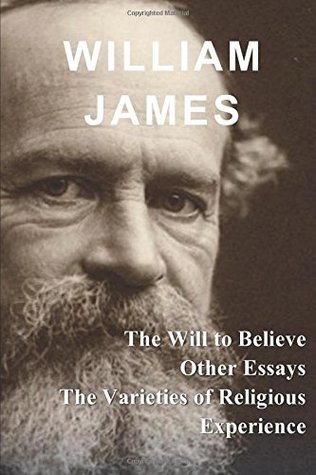
Download William James: The Will to Believe, Other Essays, & The Varieties of Religious Experience - William James | PDF
Related searches:
The will to believe: friedrich nietzsche and william james against scientism the first, which nietzsche calls “the unconditional will to truth,” is that the aims.
In will to believe,” james argues that under certain conditions we have the right to hold faith-based beliefs. The first of these conditions is that the option of whether or not to adopt the belief must be “genuine. ” for james, options that fit into the “genuine” category are forced, and momentous.
James originally delivered the the will to believe as a lecture in 1896, and published it soon afterwards. He explains that the will to believe is an essay on the justification of faith, a defense of our right to adopt a believing attitude in religious matters, in spite of the fact that our merely logical intellect may not have been coerced.
The will to believe is a lecture that was presented by william james in 1896, it specifically defends that one can choose to believe in a religion without prior evidence of its truth. William james was a well-distinguished philosopher as well as a psychologist and a physician.
Some reflections on william james' essay: the will to believe bob corbett class lecture. This essay is of special interest to our course since a significant part of it is concerned with critical thinking. James doesn't call it that, he talks about it as the scientific methods of seeking truth, or in other places as empiricism.
William james (1842–1910) spent his career teaching philosophy and the new science.
American philosopher and psychologist william james was considered one of the late 19th century's leading thinkers and the father of american psychology.
The will to believe1 by william james i let us give the name of hypothesis to anything that may be proposed to our belief; and just as the electricians speak of live and dead wires, let us speak of any hypothesis as either live or dead.
He who takes for his hypothesis the notion that it is the permanent form of the world is what i call a radical empiricist.
Read reviews and buy the will to believe and human immortality - by william james (paperback) at target.
29 nov 2010 in the will to believe, james references pascal's wager – the argument that belief in god is rational because, if true, the believer stands to make.
- james feels that most of our beliefs cannot be settled by the intellect alone, and deems it absurd to claim that are beliefs are modifiable at will - he believes that you cannot will a dead hypothesis back to life - for him evidence is really important but it isn't everything, we all hold beliefs that we do not fully understand.
An explanation of william james's paper the will to believe as a response to william clifford's paper the ethics of belief.
As in any essay or doctrine, there is a thesis statement and systematic proofs that support and reinforce that thesis. In william james's 1896 lecture, the will to believe, the thesis is that.
Psychologist william james now stands as one of the true intellectual titans to come out of late 19th century america.
11 according to james, it is legitimate to believe propositions which cannot be settled by intellectual means when the choice meets some specific contextual circumstances. We can illustrate this by reference to one of james’s examples.
The will to believe, and other essays in popular philosophy by william james.
Wesley robbins indiana university south bend lecture notes from p358 american philosophy.
In this article by william james, it is clear that he criticizes the views of william kingdon clifford, who argued in the ethics of belief, that it is always wrong to believe anything for which the evidence is insufficient.
The will to believe is a lecture by william james, first published in 1896, which defends, in certain cases, the adoption of a belief without prior evidence of its truth. In particular, james is concerned in this lecture about defending the rationality of religious faith even lacking sufficient evidence of religious truth.
Science, religion, and secularism, part xxxi: william james—the will to believe. In our last article, we explored william kingdon clifford's the ethics of belief, in which he argued that it is wrong, always, everywhere, and for everyone, to believe anything on the basis of insufficient evidence. Someone who takes the position in epistemology, that all beliefs must be grounded on sufficient evidence), but an evidentialist who holds that.
Although james's psychology does not always parallel the commitments of embodied cognition, his in- sights concerning the role of emotion and socio- cultural.
William will to some quotes and summaries the book only deal with faith and belief, james also talks extensively of science, empiricism, pragmatism and society.
In his famous essay “the will to believe”-originally delivered as a lecture to the philosophical clubs of yale and brown universities in 1896—james offers a straightforward challenge to clifford’s views, which will be highlighted in this essay. William james (1842–1910) was a central figure in nineteenth-century american intellectual life, renowned for his contributions to philosophy and for his pioneering work in the newly minted discipline of psychology.
This article focuses on the legacy of johann gottfried von herder, friedrich schleiermacher, william james and paul ricoeur.
James followed up “the will to believe” with 20 lectures delivered in edinburgh, scotland, and published in 1902 in a book he titled the varieties of religious experience: a study in human nature. Written when james was suffering from heart failure, varieties became a best-seller and his most influential work.
Perhaps the best-known example of an independent-argument is found in william james's.
William james was a 19th century philosopher who asserted belief without evidence is permissible. In his famous writing, the will to believe� he argued belief without evidence can be beneficial.
“the will to believe” by william james william james, thoemmes about the author. William james (1842-1909), both a philosopher and a psychologist, was an early advocate of pragmatism. He thought that a be-lief is true insofar as it “works,” is useful, or satisfies a function.
The will to believe and other essays in popular philosophy (1897) advances the argument that each of us has the right to believe in hypotheses that are not susceptible to proof, and that such beliefs might actually change the world. The conversational style of theses essays reflects their origin in public lectures, as well as james’s conviction that truth can be discovered as much in the course of everyday life as in the activities of science or of philosophical speculation.
Clifford's essay of 1876, discussed by william james in his 1906 'the will to believe'.
1 may 2018 the will to believe is a lecture by william james, first published in 1896, which defends, in certain cases, the adoption of a belief without prior.
24 may 2013 he discusses a classic debate on that subject, between philosophers william james and william clifford.
William james (1842 - 1910) was an american psychologist and philosopher.
William james’s will to believe argument the argument presented by william james (1842–1910) in his 1896 essay, “the will to believe”, extends far beyond the issue of the rationality of theistic belief to include various philosophical issues (for instance, whether to embrace determinism or indeterminism), and even matters of practical life.
Afraid of life, believe that life is worth living and your belief will help create the fact.
2 apr 2020 this lecture discusses the 19th-20th century philosopher and psychologist, william james, and focuses on his essay, the will to believe.
For this 1897 publication, the american philosopher william james (1842–1910) brought together ten essays, some of which were originally talks given to ivy league societies. Accessible to a broader audience, these non-technical essays illustrate the author's pragmatic approach to belief and morality, arguing for faith and action in spite of uncertainty.
86 average rating, 13 reviews the will to believe quotes showing 1-2 of 2 “it is as if a man should hesitate indefinitely to ask a certain woman to marry him because he was not perfectly sure that she would prove an angel after he brought her home.
William james he defines a live choice in opposition to a dead choice.
Thesis statement: “our passional nature not only lawfully may, but must, decide an option between propositions, whenever it is a genuine option that cannot by its nature be decided on intellectual grounds. 1) the influence of the passions is normal and unavoidable in respect to genuine options that we face.
James defends the view that we should allow our passions to decide the answer to certain questions. -whether or not we believe in god will one one of those questions. James argues for this on both methodological and consequentialist grounds.
James indicates the situation in his university --namely, that free-thinking students do not believe one should have religious faith since it cannot be rationally demonstrated.
Analysis of james: the will to believe i james on the other hand thinks that occasionally despite what evidence points to, that if true beliefs are more important, then believing without strong evidence may be sufficient.
William james's the will to believe has been criticized for offering untenable arguments in support of belief in unvalidated hypotheses*.
We use cookies to distinguish you from other users and to provide you with a better experience on our websites.
William james, the will to believe abstract: james argues that when some hypotheses of ultimate concern arise, if we do not choose, we lose any possibility for meaningful encounters because our faith pragmatically shapes future outcomes. Tutorial notes based on chapter 13, william james, the will to believe, introduction to ethical studies: an open source reader.
In “the will to believe,” william james develops two distinct arguments for the legitimacy of holding a belief on what he calls unintellectual grounds.
Post Your Comments: